How are organizations, processes, and culture changing as a result of the use of AI?
AI Transformation, Management & Leadership
Artificial intelligence (AI) will have a major impact on the structure, processes, and culture of companies across many industries. The scope and depth of this transformation can vary significantly from one company to another.
Depending on the department and role, the applications and effects will lead to significant adjustments in processes. Consequently, this will also have a long-term impact on a company’s culture.
What Is an AI Transformation?
Since AI agents in companies are a new colleague—not just another IT system—the way executives and employees collaborate with AI takes on a whole new dimension. The combination of social and technical skills, and the design of interactions between humans and machines, is what sets an AI transformation apart.
The AI transformation of organizations therefore does not focus solely on technology and data to plan, implement, and maintain relevant applications. The commitment and skills of the executives and employees involved in using AI are equally important.
What are the key issues in AI transformation?
Management and leadership unlock the potential of AI applications so that the goals set out in the AI strategy can be achieved. These “soft factors” enable the “hard factors” (technology, data structure and security, governance, etc.) to be successfully implemented.
The topic of decision-making with AI is therefore of paramount importance. This is where it becomes clear whether the collaboration between executives and employees with AI is successfully implemented. Ultimately, people bear the responsibility. This also applies when AI makes decisions independently.
What is the process for AI transformation?
The first step toward a successful AI transformation is assessing the level of readiness within the organization, a specific department, or a team. This assessment also includes evaluating the necessary skills for AI management and leadership.
As a result, the readiness assessment provides the following insights for management and leadership:
- Identification of areas for action and potential conflicts in human-machine interaction
- A program to integrate measures for people and with machines
- Success metrics for continuously monitoring results during the AI transformation.
The results of the AI transformation, management, and leadership should, of course, be continuously evaluated to optimize the next steps. In the following two subsections, you will find more details on the approach:
Where can I find more information about AI transformation?
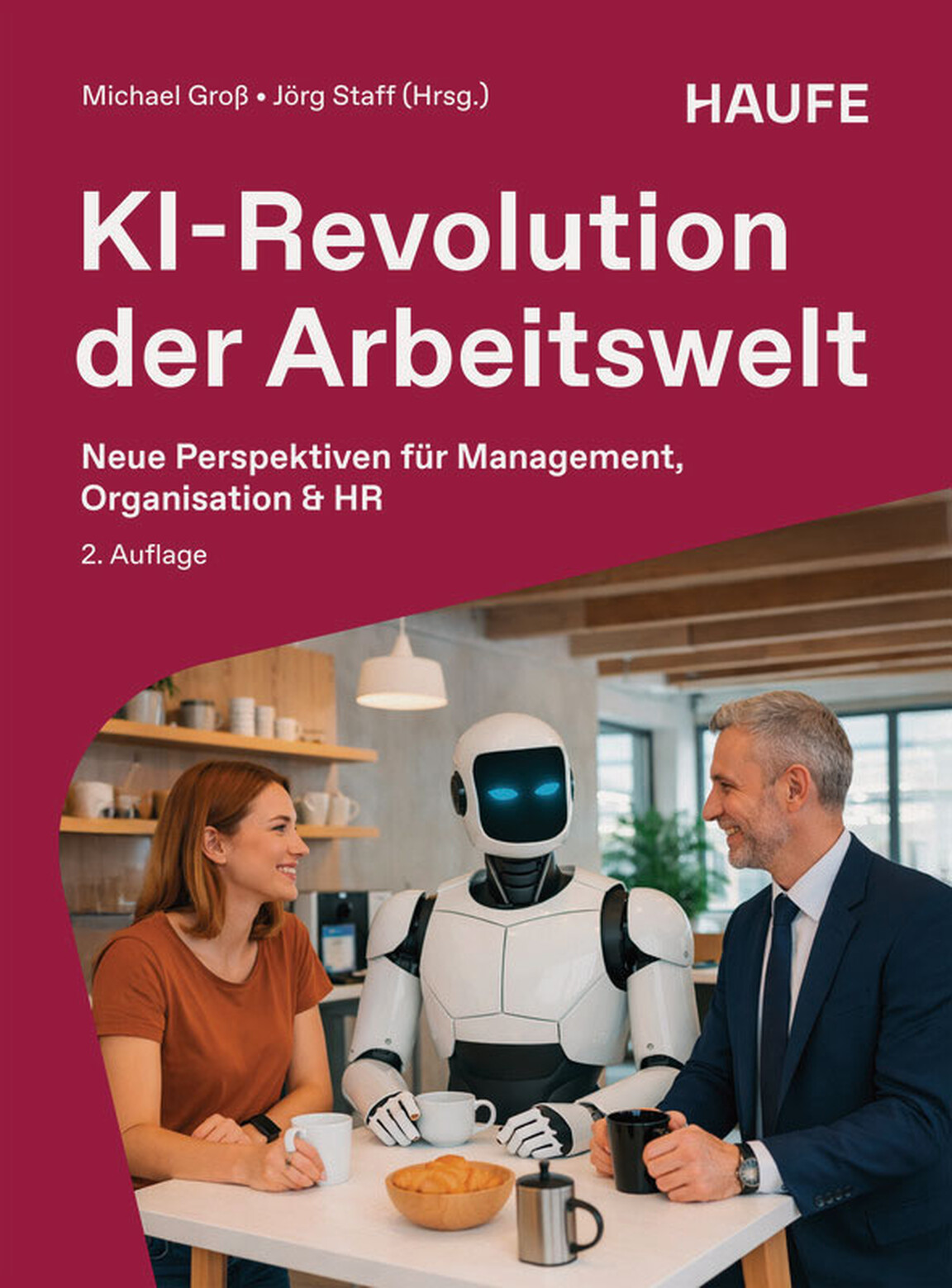
The book *AI Revolution in the World of Work* contains articles on all key topics related to the AI transformation. Michael Groß, Managing Director of Groß & Cie., served as co-editor and author of this anthology published by the renowned Haufe Publishing House, featuring contributions from prominent experts on AI transformation (DFKI, Fraunhofer IAO, etc.).
The articles not only provide an overview of the current state of research. Rather, numerous real-world examples (Deutsche Telekom, Infineon, REWE, SAP, Workday, ...) demonstrate how AI can be used in companies in a productive, secure, fair, and transparent manner.
More about the book “The AI Revolution in the World of Work”
We’re ready to help you with your AI transformation. We’d be happy to discuss an approach tailored to your needs and plans. You can reach Managing Partner Michael Groß on his cell phone at 0171 2428 624. Or send him an email.