
Why is the commitment of executives and employees so crucial for companies?
RETENTION MANAGEMENT FOR EXECUTIVES AND EMPLOYEES
Cost is the first major reason: Depending on the industry, it can take an investment equivalent to up to one year’s salary before a new employee is fully productive—primarily in terms of the costs and effort involved in the search, selection, and onboarding processes. If the hire is a poor fit, there are additional costs for the search to begin again. Furthermore, a company’s revenue can suffer from excessive employee turnover. Therefore, retaining employees—especially “high potentials”—is of central importance for all companies.
The use of AI can weaken employee retention in many industries. This is true if a company does not use AI at least to the extent customary in its industry. The workplace becomes less attractive if AI does not eliminate tedious tasks. Opportunities for developing one’s own skills are reduced. Proactive retention management addresses the foreseeable needs of employees while simultaneously strengthening an organization’s performance.
How does retention management work?
Companies have many “levers” at their disposal to retain employees. Successful retention management applies the appropriate levers in each case. This varies from company to company and often requires differentiating among individual employee groups, departments, or locations, depending on their needs. These needs can also change, for example, in response to competitors’ activities or new technologies.
Retention management takes a forward-looking approach. The “Retention Profile” assesses an organization’s current status, including its shortcomings and needs, and establishes the appropriate strategy for future employee retention. This way, the specific starting point of a company, department, or location serves as the basis for targeted measures.
The “Retention Navigator” enables the ongoing, optimal management of retention management activities. This ensures that resources—particularly personnel and budget—are consistently utilized in the best possible way, even as needs change due to new developments, such as the use of AI. You can learn more about these two solutions on this page.
The following figure illustrates the various areas of focus for retention management:
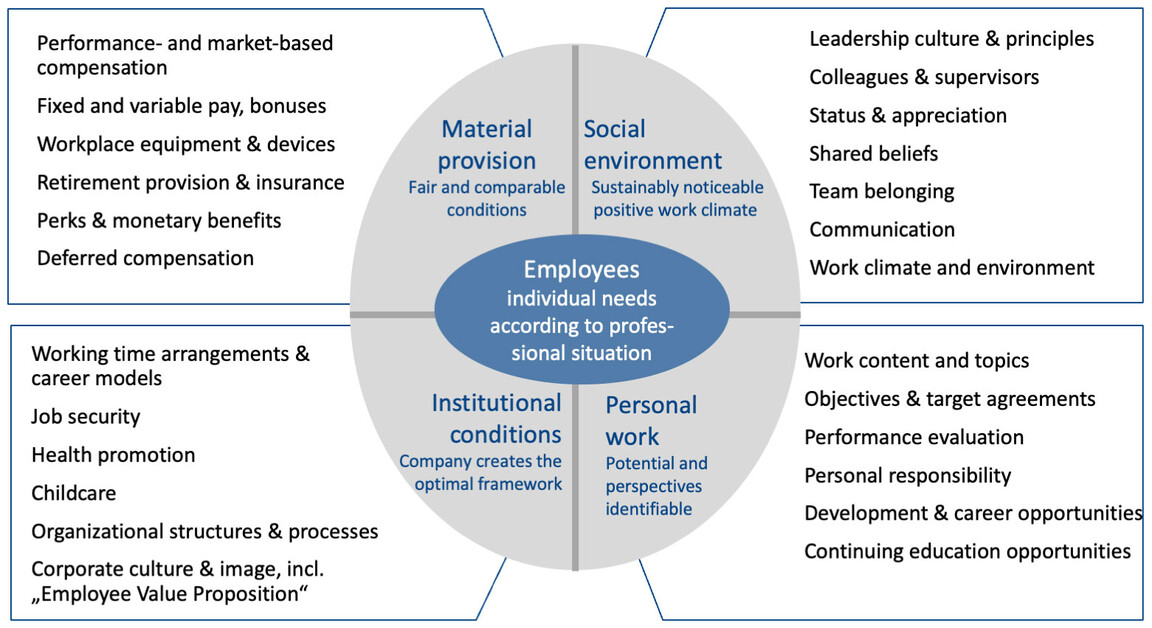
What factors have the greatest influence on employee retention?
In addition to salary, leadership quality and career development opportunities, meaningful work, and corporate culture often play a significant role. Studies have repeatedly shown that the relationship with one’s direct supervisor is one of the strongest factors influencing retention or the decision to resign—often more important than salary alone.
In recent years, the use of AI has become increasingly important. Companies that lag behind the competition in AI adoption face long-term challenges in attracting and retaining managers and employees. This is because they lack the career development opportunities needed to align employees’ job profiles and individual skills with future requirements.
How can you identify employees early on who are considering leaving?
Typical early warning signs include waning engagement and declining participation in projects or meetings. In addition, more frequent short-term absences or a noticeable withdrawal from informal team networks can be indicators if there are no other plausible reasons for the behavior. For the company as a whole, a sustained increase in the sick leave rate may point to fundamental problems with employee retention.
Systematic monitoring—for example, through regular feedback sessions or pulse surveys—can help identify patterns of declining engagement. It is crucial not to wait until resignation letters have been submitted before noticing and evaluating these signals.
Frequently Asked Questions About Retention Management.
We’d be happy to discuss the potential of new ways of working and work environments for your organization. Managing Partner Dr. Michael Groß can be reached by cell at 0171 2428 624. Or feel free to send him an email.